Reptiles & Amphibians
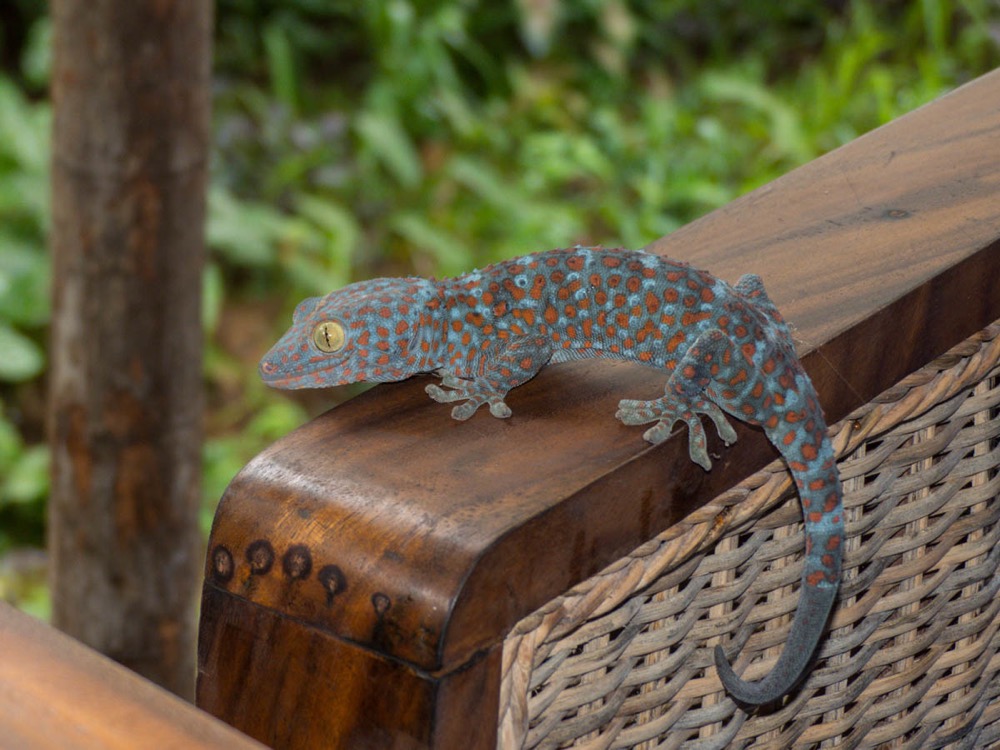
Tokay Gecko
Gekko gecko
Care level
Advanced
Lifespan
10 to 15 years, sometimes longer
Adult size
25 to 35 cm including tail
A large, boldly blue-and-orange spotted Asian gecko that is spectacular to look at but notoriously bad tempered. Tokays are fast, strong and quick to bite hard, latching on and refusing to let go, which makes them a display animal for experienced keepers rather than a hands-on pet. They are loud, calling out their name tok-kay from cover, and are arboreal and mostly nocturnal.
Housing & setup
An arboreal species that needs a tall, secure, front-opening enclosure of at least 60 x 45 x 60 cm for one adult, with a vertically oriented thermal gradient (warm high, cooler low). Provide many broad cork slabs, bamboo, thick branches and dense live or artificial foliage so the gecko can wedge into hides off the ground. Use a moisture-retaining substrate such as coco husk or bioactive soil, and mist to keep humidity up. Because tokays are strong and defensive, a well-sealed enclosure and a confident maintenance routine are important.
Diet & feeding
A hungry insectivore that eats a wide range of gut-loaded insects such as crickets, dubia roaches, locusts and black soldier fly larvae, with the occasional pinky mouse for large adults. Dust feeders with calcium at most feeds and a multivitamin once or twice weekly. Feed juveniles daily and adults every two to three days. A shallow water dish plus misted droplets provide drinking water, as tokays often lap water off leaves and glass.
Temperature, light & environment
Provide a warm basking area high in the enclosure of about 30 to 33 C, a cooler lower zone of 26 to 28 C, and a night drop to roughly 24 to 26 C. Control heat with a thermostat and give shade so the gecko can escape it. Tokays are nocturnal but benefit from a low to moderate forest-type UVB tube giving a basking UVI of about 1.0 to 2.0. Keep humidity around 60 to 80 percent with regular misting and good ventilation, avoiding constant saturation which causes respiratory disease. Run a 12-hour light cycle.
Company & handling
Keep singly, or at most one male with one female in a large enclosure, as males are highly territorial and will fight. Tokays are defensive and will bite readily and painfully, so they are best treated as a look-but-do-not-touch species; handling should be minimal and only for essential health checks using gentle restraint. They do not need or enjoy human interaction.
Enrichment & exercise
Provide plenty of vertical cover: overlapping cork bark, bamboo tubes, branches and dense foliage give this ambush hunter places to wedge, stalk and hide. Live planting, leaf litter and varied climbing routes encourage natural behaviour, and scatter or tong-feeding insects at night lets the gecko hunt as it would in the wild.
Common health problems
Respiratory infection
Signs: Open-mouth breathing, bubbles or mucus at the nose or mouth, wheezing, lethargy, loss of appetite
Prevention: Maintain correct warm temperatures with good ventilation and avoid constant saturating humidity
Metabolic bone disease (MBD)
Signs: Soft or swollen jaw, bent limbs, tremors, weak grip, poor climbing
Prevention: Dust insects with calcium, provide low to moderate UVB, and supplement D3 correctly
Dysecdysis (retained shed)
Signs: Stuck skin on toes and tail, retained eye caps, dull constricting bands
Prevention: Keep humidity around 60 to 80 percent, provide humid hides and rough bark, and check toes after shedding
Mouth and bite-related injury
Signs: Swelling or discharge in the mouth, damaged jaw, reluctance to eat, drooling
Prevention: Avoid oversized or hard live prey, keep husbandry correct, and treat any early mouth infection promptly
See a vet urgently if...
- !Open-mouth breathing with mucus or bubbles (respiratory infection)
- !Soft or swollen jaw and bent limbs (MBD)
- !Refusing food for more than two to three weeks with weight loss
- !Retained shed constricting toes or tail tip
- !Swelling, redness or discharge in the mouth (mouth rot)
In Macau
Tokay geckos are native to warm, humid parts of Asia so Macau's climate suits them, but summer heat can still push a closed enclosure too high, so monitor the warm zone and provide ventilation. Any UVB tube should be replaced every 6 to 12 months. Tokay geckos are listed on CITES Appendix II due to heavy collection for the pet and traditional medicine trades, so buy only legally sourced captive-bred animals with paperwork and avoid wild-caught imports, which are stressed and often parasitised.
The tokay gets its name from its loud territorial call, a repeated to-kay that carries through the night, and it is one of the few geckos with a genuine voice used to defend territory and attract mates.
Questions about your exotic pet?
Our team sees small mammals, birds, reptiles and fish. Book a wellness check or a species consult.
Book an exotic consultRelated care sheets
General guidance reviewed by the Royal Veterinary Center team. Not a substitute for a veterinary examination. Always confirm species-specific and legal requirements for Macau.