Fish & Aquatics
Swordtail
Xiphophorus hellerii
Care level
Beginner
Lifespan
3 to 5 years
Adult size
Females up to about 16 cm, males up to about 14 cm including the sword
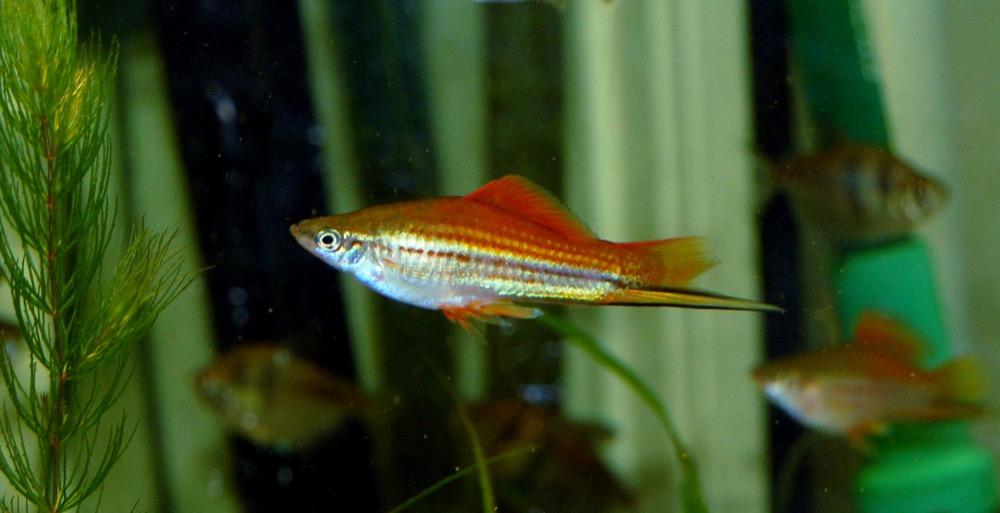
Swordtails are hardy, active livebearers closely related to platies, with the males instantly recognisable by the long sword like extension trailing from the lower tail fin. They are strong, energetic swimmers with big personalities, peaceful in a well planned group but prone to jumping, so a secure lid is essential. Like all livebearers they breed readily and give birth to live young.
Housing & setup
Because they are larger and more active than platies, a group needs a minimum of about 80 litres, and a longer tank is better for these powerful swimmers. Plant the edges and leave open central swimming space, and above all fit a tight fitting lid, since swordtails are notorious jumpers that will leap from an open tank. Keep the water filtered and heated.
Diet & feeding
Swordtails are omnivores, so feed a good quality flake or pellet as the staple, with added vegetable matter or algae and occasional frozen brine shrimp or daphnia. Offer small amounts once or twice a day that they finish quickly, and avoid overfeeding, which quickly pollutes the water in a busy, active tank.
Temperature, light & environment
Keep the water at 22 to 26 degrees Celsius, pH 7.0 to 8.4, and moderately hard to hard, as they share the livebearer preference for harder, alkaline, mineral rich water. The tank must be cycled with ammonia at 0 and nitrite at 0 and nitrate low. Dechlorinate tap water and change about 25 percent weekly with matched temperature water.
Company & handling
Keep more females than males, about two to three females per male, because males are territorial and will chase and harass rivals and females alike. It is often best to keep a single male with several females, or a group with plenty of space and cover to break up aggression. They are otherwise peaceful with other calm community fish and produce regular batches of live fry.
Enrichment & exercise
Open swimming lanes are important for these active fish, combined with planted areas and gentle current to swim against. Plants and floating cover give fry a refuge and let subordinate fish escape a dominant male, keeping the group calm and confident.
Common health problems
Ich (white spot)
Signs: White salt like spots, flashing against surfaces and clamped fins.
Prevention: Quarantine new fish, keep the temperature stable and maintain clean, cycled water.
Fin rot
Signs: Ragged or receding fins, sometimes with a milky edge.
Prevention: Keep water pristine and cycled and avoid overcrowding, injuries and stress.
Fungal infection
Signs: Fluffy white or grey cottony growths on the skin or fins.
Prevention: Maintain excellent water quality, reduce fighting injuries and remove uneaten food.
Camallanus internal worms
Signs: Red thread like worms protruding from the vent, thinness despite eating and a swollen belly.
Prevention: Quarantine new livebearers, keep water clean and treat promptly with a suitable dewormer.
See a vet urgently if...
- !Gasping at the surface or laboured breathing
- !Fins clamped and body held stiffly
- !White spots or cottony patches appearing
- !Refusing food and hiding away from the group
- !Belly swelling with raised pinecone scales
In Macau
Dechlorinate Macau tap water before use. Swordtails are hardy and Macau's harder tap water suits their preference for mineral rich water, so they are a good beginner livebearer. The key practical point is a tight fitting lid, since swordtails jump readily and will escape an open tank, and watch that the water does not overheat during Macau's hot summers.
Only male swordtails grow the long sword, an extension of the lower tail fin used to attract females, and a dominant male can even change colour and behaviour as he matures, with the sword itself playing no part in swimming.
Questions about your exotic pet?
Our team sees small mammals, birds, reptiles and fish. Book a wellness check or a species consult.
Book an exotic consultRelated care sheets
General guidance reviewed by the Royal Veterinary Center team. Not a substitute for a veterinary examination. Always confirm species-specific and legal requirements for Macau.