Fish & Aquatics
Guppy
Poecilia reticulata
Care level
Beginner
Lifespan
2 to 3 years
Adult size
Males 3 to 4 cm, females up to 6 cm
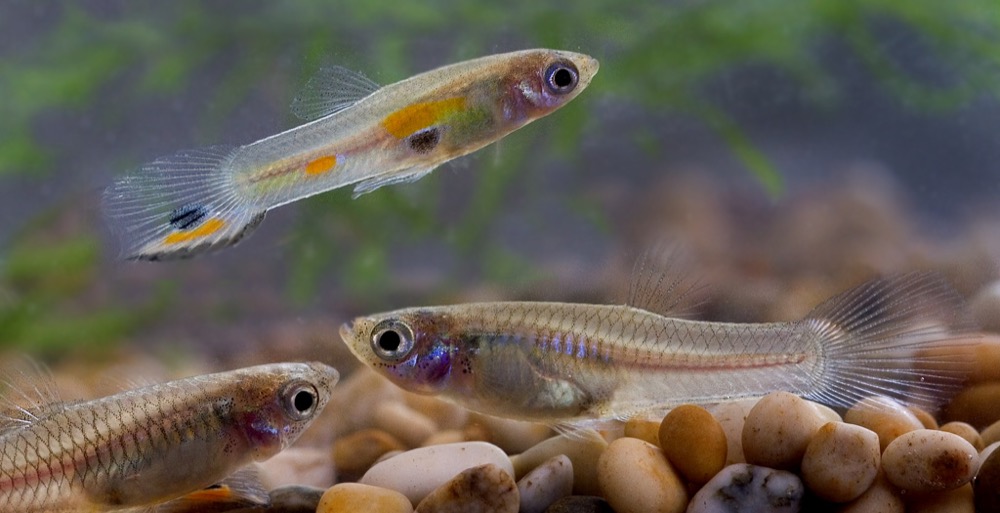
Guppies are small, hardy, endlessly colourful livebearers and one of the best fish for beginners. Males show off dramatic tails and patterns, while the larger plainer females give birth to live young rather than laying eggs. They are active, peaceful, and breed so readily that population control becomes the main challenge.
Housing & setup
A group needs a minimum of about 40 litres, filtered and heated, with plenty of open swimming space and some planting. Live or silk plants give fry places to hide and help diffuse light. A gentle filter keeps water clean without pushing these small fish around, and a lid is wise because guppies can jump.
Diet & feeding
Guppies are omnivores, so feed a good-quality flake or micro-pellet as the staple, with occasional frozen brine shrimp or daphnia and a little blanched vegetable matter. Offer small amounts once or twice a day that they finish in under a minute. Overfeeding quickly pollutes the water and is a common beginner mistake.
Temperature, light & environment
Keep the water tropical at 22 to 28 C, pH 7.0 to 8.0, and moderately hard, since these livebearers prefer harder mineral-rich water. The tank must be cycled with ammonia at 0 and nitrite at 0 and nitrate low. Dechlorinate tap water before use, and change about 25 percent weekly.
Company & handling
Guppies are social and should be kept in groups. Because they breed constantly, keep either a single-sex group or a ratio of about one male to two or three females so no single female is harassed, and be ready for regular batches of fry. They mix well with other small, peaceful community fish.
Enrichment & exercise
Dense and floating plants give fry cover and adults places to explore, while gentle current and peaceful tankmates keep them active and confident. A varied planted layout suits their busy grazing behaviour.
Common health problems
Ich (white spot)
Signs: White salt-like spots, flashing, clamped fins.
Prevention: Quarantine new fish, keep temperature stable, and maintain clean water.
Fin rot
Signs: Ragged or receding fins, sometimes with a milky edge.
Prevention: Keep water pristine and cycled and avoid overcrowding and stress.
Velvet
Signs: Fine gold or rust-coloured dust on the skin, lethargy, rubbing.
Prevention: Quarantine newcomers and keep water warm, clean, and stable.
Columnaris (bacterial)
Signs: White or grey cottony patches, especially around the mouth, and frayed skin.
Prevention: Avoid overcrowding, keep water quality high, and reduce stress and injuries.
See a vet urgently if...
- !Gasping at the surface or laboured breathing
- !Fins clamped and body held stiffly
- !White spots or cottony patches appearing
- !Refusing food and hiding away from the group
- !Belly swelling with raised pinecone scales
In Macau
Dechlorinate Macau tap water before use. Guppies are very hardy and forgiving, which suits Macau beginners, and they are readily available in local aquarium shops. Watch tank temperature during hot summers so it does not climb too high.
Guppies are livebearers, and a single female can store sperm to produce several batches of live young from just one mating, which is why decades of selective breeding have created hundreds of colour and tail strains.
Questions about your exotic pet?
Our team sees small mammals, birds, reptiles and fish. Book a wellness check or a species consult.
Book an exotic consultRelated care sheets
General guidance reviewed by the Royal Veterinary Center team. Not a substitute for a veterinary examination. Always confirm species-specific and legal requirements for Macau.